Sunday, January 7, 2024

The Diabolik Phenomenon 2-Crimes for commuters

Miriam Leone (Eva Kant) and Monica Bellucci (Altea von Vallenberg)
in "Diabolik, who are you?" (2023) - 01 Distribution

The two ladies from Milan who became partners in crime

How come two fictional criminals become household names and movie heroes? Let’s start from the very beginning: in 1961 former model and amateur plane pilot Angela Giussani has been married for fifteen years with horror, science-fiction and sexy-ish comics publisher Gino Sansoni, owner of Casa Editrice Astoria and Gino Sansoni Editore, with headquarters in a flat in via Leopardi, Milan. In 1961 Angela decides to become a publisher on her own and opens - in the kitchen (cucina) of the same flat - Astorina (literally, ‘small Astoria’), specialized in comics, called fumetti in Italian, since the dialogue balloons recall puffs of smoke (fumo). Astorina starts publishing Elliot Caplin’s Big Ben Bolt comics from the US, which don't seem to be particurarly succesful in Italy. Then Angela decides to write something new and her younger sister Luciana joins her as co-author. They don’t expect their new creation will be so groundbreaking as it will turn out to be.

Angela Giussani (1922-1987) and Luciana Giussani (1928-2001)

Two myths surround the birth of Diabolik and both are connected with railways. Myth one: while travelling by train, Angela finds on a seat an abandoned copy of the first Fantômas novel (1911) by French authors Allain and Souvestre, reads it and finds the inspiration for a modern day mysterious criminal with no name and many faces. Myth two: from the window of Astorina overlooking the Stazione Nord, the Milan railway station of Ferrovie Nord, Angela and her sister Luciana see thousands of commuters coming and going every day; so they conceive a comic book that people can buy in newsstands, carry easily in a pocket or a bag and read comfortably on the way to work or home, even while standing in an overcrowded train. Stories have to be gripping, so they might be crime stories, something still unusual in Italian-made comics at the time. And that’s what they set themselves to do.


In 1962 crime novels (gialli in Italian, learn here the origin of the word) are a huge hit in Italian newsstands, a good reason for Angela and Luciana Giussani to consider creating a giallo a fumetti. And what about something really new, such as crime comics where the real ‘hero’ is an unpunished criminal, like Fantômas? At the time, in books, films and comics, robbers and burglars get always jailed or killed in the end, or at least lose their loot. The rules imposed to Hollywood movies by the Hays Code have become a standard everywhere, including French noir masterpieces of the Fifties such as Auguste Le Breton's novel Rififi or Albert Simonin's novel Grisbi, both turned into films.
There must be something in the air, because in 1962 American writer Donald E. Westlake, writing under the pen name ‘Richard Stark’, lets his editor convince him that Parker, the robber in his novel The Hunter, should stay alive and free at the end of the book, and return in further novels. Good idea, since Parker will become an icon of caper fiction: he will appear in twenty-four novels and a few times on the big screen, with the likes of Lee Marvin, Mel Gibson or Jason Statham. Donald/Richard will write about his ‘James Bond of crime’ till his death, on december 31st 2008.
As Diabolik current author Mario Gomboli noted, Parker and Diabolik have some features in common: they’re both careful planners of perfect heists, both cold-blooded but not sadististic killers and both (unlike James Bond) strictly monogamous. But in 1962 only the first of Richard Stark’s books has been published and won’t arrive in Italy before 1964. For Angela and Luciana, the model is clearly Fantômas, created over half a century before in France by Allain and Souvestre.


Fantômas – whose real name is unknown – is a master of disguise, has a lover called Lady Beltham and is chased by French police inspector Juve with the help of journalist Fandor. The same cast of characters is recreated in the first three issues of Diabolik, with Diabolik himself, Lady Eva Kant, inspector Ginko and his sidekick Gustavo Garian, a character who will later fade out of the series.
Elements of the plot of the first three issues actually recall the first Fantômas novel, but with a more modern and technological approach that soon – as we’ll see – anticipates both the 007 movies and the Mission: Impossible tv series. Again, there must be someting in the air...

To be continued...

Read also


Anthology, december 2023; art: Giuseppe di Bernardo

Andrea Carlo Cappi, born in Milan in 1964 and living between Italy and Spain since 1973, is an Italian writer, translator and editor. Author of over seventy titles - most of which set in his noir/spy story universe "Kverse" - and member of IAMTW, he also writes tie-in novels for "Diabolik" and "Martin Mystère". Also a member of World SF Italia for his work in speculative fiction, in 2018 he won Italcon's Premio Italia for best Italian fantasy novel. He also works for the Torre Crawford festival and literary award, in memory of F. M. Crawford.

Tuesday, January 2, 2024

The Diabolik Phenomenon 1-Shocking a generation

 
Eva Kant (Miriam Leone) and Diabolik (Luca Marinelli) in "Diabolik" (2021)

Tie-in writer A. C. Cappi leads you into the world of Diabolik

Almost everybody in Italy knows this name. Most people, readers and non-readers alike, are aware it’s a comics series about both the eponymous masked male character and his female partner and lover Eva Kant: she just happened to make her first appearance in issue #3, when the brand name Diabolik was already established, due to the overnight success of issue #1 four months before, on november 1st 1962. With issue #2, on february 1st 1963, the series started being published monthly and since then nearly one thousand stories have appeared, including special issues, graphic novels and more.

"Diabolik-Il film" (2021) poster

By the way, Diabolik & Eva Kant are not superheroes, nor ‘heroes’ in a traditional way. They are not even ‘supervillains’, although they live in crime and use plenty of tricks in order to avoid being caught by inspector Ginko. Nor any of the three Diabolik motion pictures released since december 2021 – all based on classic comics episodes from the 60’s and directed by Marco & Antonio Manetti, aka Manetti bros – is your typical Marvel or DC movie. «We love Marvel movies», said the directors at a preview of the final chapter of the Diabolik trilogy in november 2023, «but that’s not what we have been making here.»
After all, Diabolik, still the third best-selling and second longest-running comics series in Italy, is not like anything else. More so when it was created in 1962 by Angela Giussani and her sister Luciana, changing the way comics were made in Italy and becoming a cultural phenomenon that shocked a generation.

Original sketch by Brenno Fiumali for issue #1, 1962

There was no official Comic Code Authority in 1962 Italy, only self-imposed rules, but for sure stories about two unpunished criminals who murder their way from heist to heist were unconceivable. Besides, Diabolik & Eva Kant were clearly an unmarried couple living together, something unacceptable when Italy was ruled by Democrazia Cristiana, the ultra-catholic christian democratic party that kept under scrutiny the two tv channels, both state-owned (the second channel had started broadcasting the year before).
Not to mention the fact that Eva Kant was an emancipated woman, while women in Italy were supposed to be wives, mothers and cooks. But she was a refelction of her creators Angela and Luciana Giussani. Who, anyway, signed the comics books as ‘A. & L. Giussani’, hiding the fact that two women were writing them.

Advertisement of issue #2, february 1963

Violence was present in Diabolik, but never graphic and no explicit sex has ever been shown. Though, in little more than one year, its success would spawn several exploitation comics by other authors, featuring outlaw characters, men and women, usually with the letter K in their names – Zakimort, Kriminal, Satanik, Sadik, Killing... – some of them more open to nudity and violence. All were labeled ‘adult comics books’ which families did not allow children to read, making them even more appealing to a younger audience.
Soon judges would order the retiring of comics books from the newsstands and one even took the Giussani sisters to trial (they’d be acquitted), while newspapers led a crusade against the so-called "horror comics". But the rebellious year 1968 was getting nearer and nearer, and in the end nobody could stop the revolution. By the way, many of those "K" comics would become classics themselves, though only Diabolik would survive the Seventies and keep sailing beyond 2000.


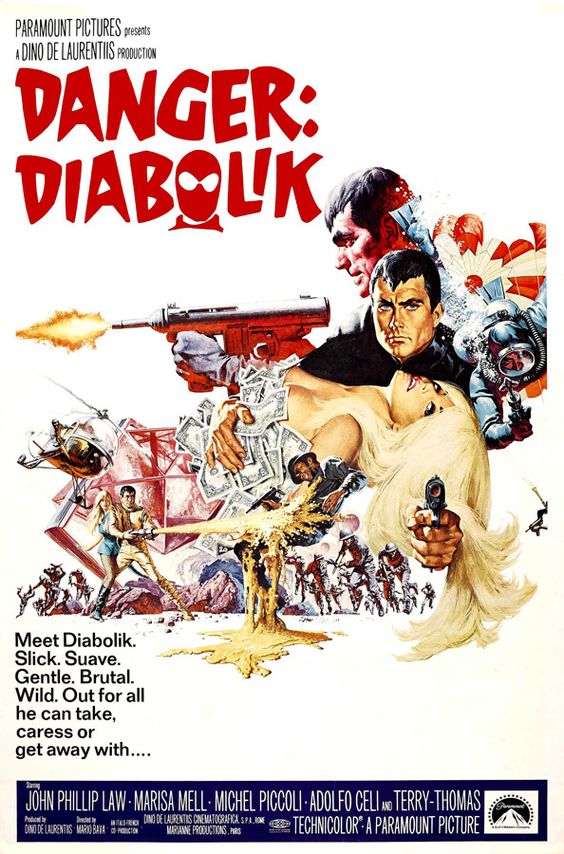
Before the end of the Sixties, Diabolik was translated in several countries. A few episodes were adapted into two different novelization series, one in Italy and one in France. In 1968, the pop-cult movie Danger: Diabolik directed by Mario Bava, featuring an international cast and an original soundtrack by Ennio Morricone, was released world-wide by Paramount Pictures (though a few scenes were safely censored in the Italian version, in order to avoid restrictions).
In time, Diabolik also inspired radio and audio serials, music, art, fashion, the world-wide tv cartoon series Diabolik-Track of the Panther (1999.2001), new tie-in novels since 2002, the adventure game Diabolik-The Original Sin (2007) and an alternative universe comics mini-series titled DK (2015-2019). While Diabolik was reaching its 60th birthday, four movies have been released: Diabolik sono io, a 2019 docu-fiction film by director Giancarlo Soldi, based on the mystery behind issue #1, and the Manetti bros trilogy: Diabolik-Il film (2021), Diabolik-Ginko all'attacco (2022) and Diabolik, chi sei? (2023).
As the official tie-in novels and novelizations writer and the author of an authorized non-fiction book called Fenomenologia di Diabolik (2017), let me be your guide in this world of mystery and heists, love and passion, and crime without punishment.

To be continued...

Read also


Andrea Carlo Cappi, born in Milan in 1964 and living between Italy and Spain since 1973, is an Italian writer, translator and editor. Author of over seventy titles - most of which set in his noir/spy story universe "Kverse" - and member of IAMTW, he also writes tie-in novels for "Diabolik" and "Martin Mystère". Also a member of World SF Italia for his work in speculative fiction, in 2018 he won Italcon's Premio Italia for best Italian fantasy novel. He also works for the Torre Crawford festival and literary award, in memory of F. M. Crawford.

Sunday, December 31, 2023

Happy 2024 from the Kverse


Happy new year from Italian writer A. C. Cappi to you... and to them.
Who are they and why 2024 is so important for them? They are the main contemporary characters of my Italian language spy-story/noir literary universe that has been called "Kverse" and have entertained about one hundred thousand Italian readers for almost thirty years.
From left to right, Italian hitman Carlo Medina (no relationship with the character of the same name in the tv series Ugly Betty), Bolivian hitwoman Rosa "Sickrose" Kerr, Spanish private detective Toni "Black" Porcell and Spanish contractor Mercedes "Nightshade" Contreras, also called "Mercy". Each one has her/his own series, although they all frequently work with Mercy in her Nightshade/Agente Nightshade series.
Medina was the first to be published, in the novelette Milano da morire on the special 1994 Christmas issue of 'Il Giallo Mondadori". This makes 2024 the 30th anniversary of the Kverse, now reaching around thirty titles (including three collections of short stories and novelettes) plus various short stories - still uncollected - and twelve Dark Duet novelettes (and more to come) published in ebook, featuring characters of a previous generation in the early years of the Cold War.
Actually, I've been living in this "universe" for quite a long time: I started working on it in 1978 (I was 14 at the time) and brushed up the material in the early Nineties. Since 2002 I've been publishing Kverse novels in the "Segretissimo Mondadori" collection mostly under the pen name François Torrent. Since 2019, older titles have been republished in a collection from Oakmond Publishing, all under my real name, Andrea Carlo Cappi. I'm currently working on two new novels for Mondadori in 2024. Wishing to myself that in the new year the Kverse might start being available at last to readers outside Italy.

Andrea Carlo Cappi, born in Milan in 1964 and living between Italy and Spain since 1973, is an Italian writer, translator and editor. Author of over sixty titles - most of which set in his noir/spy story universe "Kverse" - member of IAMTW he also writes tie-in novels for "Diabolik" and "Martin Mystère". In 2018 he won the Premio Italia for best Italian fantasy novel.

Tuesday, September 14, 2021

The unknown secret of Italian Giallo


"Italian Giallo" is the definition by which the world remembers the revolutionary, shocking thrillers made in Italy in the 70's that would set the base for psychothrillers of the 80's and sometimes would mix serial killers with supernatural elements, although the word "giallo" originally meant classic murder mysteries and detective stories. Director Mario Bava was the first to lead Italian mystery movies in a new direction in the 60's, but the real Italian Giallo phenomenon started in 1970 with the huge success of Dario Argento's "The Bird with the Crystal Plumage". Not only this movie, credited to Argento both as writer and director, heavily influenced other Italian directors (Aldo Lado, Umberto Lenzi, Sergio Martino... mentioning only the ones I had the pleasure of meeting personally, but there are many, many more); it is also said to have inspired Alfred Hitchcock while making "Frenzy".
So, Dario Argento is undoubtedly the father of Italian Giallo.
But is he the only one?
On Sept. 11th, 2021, during the "Premio Torre Crawford" Festival in San Nicola Arcella (Italy), guest Aldo Lado tells a different story, which has been recently published in France, in Laure Charcossey's book "Conversation avec Aldo Lado", but was never previously heard in Italy.

Moment of revelation: Lado and Cappi in the TV news 

Let's go back to the 60's. Dario Argento is the writer of Maurizio Lucidi's war movie "Probabilità Zero", filmed in (then) Yugoslavia, with Aldo Lado as assistant director. According to Lado, Argento tells him he'd like to make a movie from Fredric Brown's "The Screaming Mimi" but he hasn't been able to obtain film rights for the novel. Lado reads the book and doesn't see it as film material, except for one thing: in the book, a man witnesses a murder and not the murderer, the murderer thinks the witness has seen it all. That would really work.
So - said Lado last saturday - they start working together on a film project of their own and, in a restaurant in Rome, they come up with a title which will become famous: "L'uccello dalle piume di cristallo". Then Lado goes back working as assistant director on various films all over the world, later including "The Conformist" by Bernardo Bertolucci, from a novel by Alberto Moravia. According to Lado, he doesn't hear about "The Bird" till, back in Italy, he reads that Argento is working on "their" film; Argento wouldn't return his calls and the movie is released only with Argento's name as writer. The lack of credit, says Lado, "delayed my career for three or four years". He adds "I didn't speak with Dario for over forty years".
In 1971 Lado is the director of an Italian Giallo of his own, filmed in Prague as "Malastrana", but the distributors choose a different title, "The Short Night of the Butterflies"; and, since director Duccio Tessari is releasing his "The Bloodstained Butterfly", the title is changed again into "The Short Night of the Glass Dolls", reminding of the "crystal plumage" of Argento's film. Meanwhile Lado has been working with Bertolucci on the project of "Last Tango in Paris", delayed because Marlon Brando got himself hired by Francis Ford Coppola in "The Godfather". Lado will miss "Tango", since he is called to film in Venice - the city where he grew up - his second giallo, "Who Saw Her Die".
He won't make another giallo - "I didn't like to make the same film twice" - although some thrilling elements appear in the shocking, highly political movie "Last Stop of the Night Train". He will later be back to something similar to giallo with a few tv productions and the film "Il notturno di Chopin". Meanwhile he adapts various novels for the screen, including one by Moravia,  "La disubbidienza". He later becomes a film producer in France and currently lives near Rome, writing novels. He also published in English the book "The Movies You Will Never See", a collection of original unused film stories of his.
Quentin Tarantino said that his two giallo movies and "Last Stop of the Night Train" are enough to consider him one of the great Italian directors. But maybe a paragraph of the history of Italian cinema should be rewritten and Dario Argento would not be the only father of Italian Giallo.

Sept. 14th, 2021


Friday, July 16, 2021

F. M. Crawford, the American writer from Italy

Torre Crawford, photo by A. C. Cappi

American writer Francis Marion Crawford (1854-1909) was a bestselling author in the late XIX-early XX. century. Today he's remembered mostly for his gothic stories, a comparatively small part of his works. Born in Tuscany, he established himself in Southern Italy, living in Sant'Agnello, Campania, and spending his summers in San Nicola Arcella, Calabria. Here he used to live in a 16th century tower that turned out to be the setting for one of the most celebrated gothic stories ever, For the Blood is the Life; since then, the tower is known as Torre Crawford.
In 2019, 110 years after his death, someone in the Calabrian town and elsewhere in Italy volunteered to create a literary contest - open to writers in Italian language - and a festival inspired by F. M. Crawford.
The first edition of Premio Torre Crawford was celebrated in San Nicola Arcella on September 19th, 2020. taking advantage of a pause in the pandemic lockdown: winners of the contest, writers and performers came to town. I edited a book in Italian which includes my translation of Crawford's story set in the town - For the Blood is the Life - a novelette by horrow/thriller top writer Cristiana Astori and the selected short stories by contestants, all inspired by the title of Crawford's story. For those who can read Italian, the book Perché il sangue è la vita (Oakmond Publishing) is available both for kindle and as an actual book on Amazon all over the world.


The second edition of Premio Torre Crawford is taking place in September 10th- 11th-12th, 2021. Guests include writer Alda Teodorani, about whom director Dario Argento declared "her stories feel like my deepest nightmares" and whose work is studied in European and American universities; master film director Aldo Lado; writer-actress Giada Trebeschi and musician-actor Giorgio Rizzo, whose short film Mia won in May 2021 at the Cineville Calcutta Global Cinefest: you can see it here. It almost seems (somehow) inspired by the same theme as tihis year's literary contest.
Because this year the Premio Torre Crawford contest and subsequent book are based on a quote from Crawford's story By the Waters of Paradise: "Falling in love with a ghost." The short story collection Innamorarsi di un fantasma will be soon available on Amazon for kindle and on paper from Oakmond Publishing, and will include my Italian translation of Crawford's abovementioned story, a short story by Alda Teodorani and fourteen short stories by the winners of the literary contest.
The following is a piece I wrote about F. M. Crawford in summer 2020 for the Italian blog Borderfiction Zone.


It was his destiny to become a genre writer and a sui generis writer. His father was American artist Thomas Crawford, one of whose statues decorates the Washington DC Capitol. Thomas moved to Rome in 1835 and in 1844 married Louisa Ward, (sister of American poet Julia Ward, known for her antislavery position and the text for Battle Hymn of the Republic). The Crawfords had four children. Three of them would dedicate themselves to literature: Anne Crawford von Rabe (b. 1846), Mary Crawford Fraser (b. 1851) and Francis Marion Crawford, born in Bagni di Lucca, Tuscany, in 1854.
Francis Marion's education was international: he studied in the US, in Cambridge, Britain, in Heidelberg, Germany and in Rome, at La Sapienza university. His family was protestant, but he became a catholic in 1880 and in 1884 married Elizabeth Berdan (in a French church in Istanbul, I read somewhere). Meanwhile he had spent two years in India and when he was back in 1882, he had published his first novel, Mr. Isaacs, based on this experience Success led him to keep on writing. He lived in Italy since 1883: first in Sorrento, then in Sant’Agnello (Napoli) at Villa Crawford. Later in San Nicola Arcella (Cosenza) he aquired an ancient Spanish tower which would be named Torre Crawford after him. From time to time he crossed the ocean to lecture in the US. During one of this trips, he caught a lung illness that would undermine his health forever.
At the top of his career, he had sold an extimated 600.000 copies, becoming a bestselling author of his time. His vision of literature was one of intelligent entertainment. He was not ashamed of dealing with adventure, love or mystery. He considered books as pocket-size theatre.
His work in superantural fiction would even influence H. P. Lovecraft, a reader of his. Crawford's bibliography includes historical novels and several books set in Italy, getting him close to writers of the Italian "Verismo" current. He died in 1909, leaving a legacy of over fifty books and four plays.


One of his best known stories was written and set in San Nicola Arcella in 1905: For the Blood is the Life, a title taken from the Bible. It's one of the world's most famour vampire stories, more exactly female vampire stories. It should be noted that another famous stories of  this kind was written by his sister Anne Crawford, who had published in 1891 A Mystery of the Campagna.
While in Anne's story, as well as in the previous Carmilla by Le Fanu (1872) the vampire has ancient origins, in For the Blood is the Life we witness the birth of the creature; before becoming a predator, she's a victim herself, of a murder committed to hide a theft: one of the many elements of social criticism in the story. It might be possible that, while writing about the rules of rural Italy - with arranged marriages and economic marginalization - he was also thinking about his American middle-class readers.
As it frequently happens in gothic stories, For the Blood is the Life is developed on two different narrative levels, the one of the narrator and the one of the narration: present, when Crawford himself nonchalantly explains to his guest on top of the tower the mysterious phenomenon they see; and past, up to the innatural love story between Angelo - a stranger in his own town - and Cristina, an independent, unconventional girl who becomes a damned in spite of herself but still keeps an innocente of her own. Sexual innuendos are evident but understated, with a modesty somehow both catholic and victorian. Nevertheless, the story maintains an extremely modern value, as classics always do.


Coming soon: F. M. Crawford's Italian legacy


Sunday, April 25, 2021

Emilio Salgari, master of adventure


April 25th is an important date in Italy: in 1945, it marked the end of World War II and freedom from fascism. But in 1911 - 110 years ago today - it was also the day one of Italy's most influential writers died. Emilio Salgari was an author of bestsellers but, exploited by publishers and overcome by financial problems, he killed himself with a razor blade.
In spite of his personal tragedy. many of his works have been in print ever since; some of them were later turned into films, comics and tv series. Translated into other languages - Spanish, for instance - they had a strong impact even on the political side: Ernesto "Che" Guevara read Salgari and learnt from him.
But most of all, for Italian readers, Salgari was a household tradition all over the 20th century: although his books were not conceived either as children's or young adults' literature, they were passed fron generation to generation, to boys and girls alike - with no censorship even during the fascist regime - and were usually the first novels we read, out first approach to literature and, even if the word was still unknown to us, to "pulp".


Born in Verona on August 21, 1862, Emilio Salgari started writing at an early age. At 20 he publishd on newspapers and weekly magazines his first serialized novels, later re-edited as proper books. Their locations were mostly foreign, exotic countries, often in contemporary war or guerrilla settings. Salgari let his readers believe he had been sailing world-wide and had first-hand knowledge of the places he described.
In fact he only lived in Verona, Venice, Genova and Turin and never left Italy. But he spent a lot of time in local public libraries studying newspapers and books, so much that he could describe faraway places in vivid details. He often wrote about turmoils in what would later be called the Third World from an indigenous, anti-colonialistic point of view. Paco Ignacio Taibo II, Mexican novelist of the so called neo-aventura and biographer of Che Guevara, once said "I learnt more about anti-imperialism from Salgari than from the Che". Authors like Isabel Allende, Jorge Luis Borges, Juan Madrid or Gabriel Garcia Marquez have declared themselves Salgari readers.
Between 1882 and 1911 the Italian writer published dozens of novels, many of them featuring Sandokan, by birth a Malaysian prince, who becomes a pirate to fight colonialism along with Portuguese adventurer Yanez de Gomera; while Sandokan is always ready for action and battle, Yanez is more keen to light himself a cigarette and rationally consider the situation. Another famous saga follows the family of the Black Corsair, an Italian count who becomes a Tortuga corsair seeking a personal revenge. Salgari wrote more historical and contemporary adventure books, including western novels, long before spaghetti western.
He was somehow considered a rival of French author Jules Verne and that might be the reason why, among Salgari's standalone books, there is also one science-fiction novel: in Le meraviglie del 2000 ("The Wonders of 2000") a rich American, disiillusioned about his time, decides to go into hibernation and wakes up in 2003 to see how the world has changed. In the novel you can even read about something like a flat-screen smart-tv with an Internet connection. The book was originally published in 1907 under the pen name Guido Altieri (while years later a real Altieri, Sergio D. known as Alan D. Altieri, would become one of the masters of Italian science-fiction).


Salgari's success was also his curse. His three-books-per-year contract meant a lot of research work (and Internet didn't really exist at the time). He was a goldmine for his publishers but not so much for himself, since he had to support a wife - actress Ida Peruzzi, who fell ill in 1903 and would die in a mental institution in 1922 - and four children. Depression, wine, hard work and cigarettes were his only company, until he chose the same way out his father had taken years before: suicide. In one of his farewell letters he announced he was "breaking his pen" and accused his publishers of exploiting him.
If so it was, his death didn't stop it. Some novels were published posthumously, other books were completed by his son Omar and a few more continuation novels were written by writers Emilio Fancelli and Luigi Motta. Even the line of tragedies went on with Salgari's daughter Fatima, who died of tuberculosis in 1914, and his sons: Nadir died in a motorbike accident in 1936, while the other two, Romero and Omar, both killed themselves in 1931 and 1963.
Nevertheless, Salgari was still the bestselling Italian author at least well into the 1970's. The first movies officially based on his books - from the Black Corsair saga - were made one century ago, in 1921; many more were filmed, including three by director Umberto Lenzi in the 60's. In 1976 the tv series Sandokan directed by Sergio Sollima and starring Kabir Bedi led to a Salgari revival and to more films and tv sequels, one of them by Enzo G. Castellari in 1996. Moreover, the adjective salgariano still describes a certain kind of pulp-style adventure novel. The writer's influence still hangs on in the works of Italian novelists and comics authors.
Unluckily, Salgari is now one of the victims of the cultural "anti-pulp" phenomenon I already described in a previous post: parents no longer pass their Sandokan books to their children and nobody would teach about the Black Corsair in schools. So the new generations miss the entrance to a world of adventures... and books. Salgari didn't really die on April 25th, 1911, but we really need to keep him alive today.


Art by A. Della Valle

Saturday, April 24, 2021

Eurospy: from France to Italy

OSS117 collected novels (1968), art by Ferenc Pinter

As you probably have guessed, by "europulp" I define the kind of popular fiction (in literature, comics, TV and movies) coming from western continental Europe and not in English language. Since the subject is much wider than you might think, I plan to deal (mostly) with the Mediterranean area, which I'm more familiar with. In this blog "pulp" is neither a derogative word, nor the definition employed in Italy in the 90's to brand a few authors that happened to be somehow close to the noir/horror genres.
There's a particular side of europulp which I decided to call "eurospy".


The term "eurospy" has been used for the 1960's Italian-French-Spanish-German film co-productions featuring secret agents. A few of those movies were based on French novels, among them the ones by Jean Bruce. His character was Hubert Bonisseur de la Bath, aka OSS117, who had appeared in books since 1949 and on screen since 1957, before Ian Fleming's 007. Just like James Bond, OSS117 is now expected in a new movie as soon as European theatres will open after the Covid-19 pandemic.
But, with due exceptions, most of those 60's movies were just exploitation, parodies or camp versions of the James Bond phenomenon. Some viewers might remember Operation Kid Brother, known in Italy as OK Connery (1967), starring Neil Connery (Sean's real brother) as "the famous secret agent's brother", plus several actors from the Bond films. Or Kiss Kiss Bang Bang (1966), starring spaghetti western star Giuliano Gemma and bearing the same title as a song from Thunderball (1965). Moreover, most ot the secret agents were voiced in Italy by Pino Locchi, one of the stars of Italian dubbing, who also gave his voice to Sean Connery (and later both George Lazenby and Roger Moore) in the Bond films.
Eurospy movies were often marketed in Italy with titles containing the numbers 070, 077 or 777, in the hope they might be mistaken for 007 movies, even when based on characters such as Francis Coplan, agent FX18, from the French novels by Paul Kenny, that had been published in Italy. But the distributors didn't mind that.


In the end, somehow, eurospy contaminated the original Bond movies: not only You Only Live Twice (1967) looked a lot like a high-budget eurospy set in Japan, but later in time some of the Bond action sequences would borrow ideas, stunts and gags from it: see for instance the ski pursuit in Kiss Kiss Bang Bang and For Your Eyes Only (1981).
Many of the 60's eurospy directors - I'd say most of them - were Italian and worked as well on spaghetti western in the 60's and in giallo or poliziottesco in the 70's. But in the 60's, spy movies had a huge market in Italy, not only due to Bondmania, but because spy stories were a familiar item to readers. I already mentioned the Italian Segretissimo book series, entirely devoted to the subgenre, from publisher Mondadori. British, American and French spy stories were a common reading in Italy, thanks to Mondadori, Garzanti and a few other publishers.
Both in France and Italy those novels were considered romans de gare, romanzi ferroviari, the kind of pocket-books you buy in a newsstand at a railway station (or an airport). In Italy Segretissimo was actualy a hybrid between a book and a magazine, following the succesful formula of Il Giallo Mondadori (for detective novels) and Urania (for science-fiction novels) from the same publisher: a format similar to Jerry Cotton and Perry Rhodan in Germany.
But, unlike the eurospy movies, even the most pulp-style spy novels had a comparatively serious approach, being inspired by the daily chronicles of the Cold War, often mixed with a certain amount of exotic adventure. That too sounded familiar to Italian readers. When I started reading Ian Fleming - published in Italy by Garzanti, at the time - I noticed how much he unknowingly had in common with Italy's great adventure writer Emilio Salgari (1862-1911), whose influence is undeniable in many Italian spywriters today: Stefano Di Marino has often been called "the modern Salgari".

The latest reprint of S.A.S. vol.1 (2015)

But there were no Italian spywriters at the time. As I'm explaining in the posts about giallo in this blog, Italian readers were not interested in thrillers - of any kind - by Italian authors and they wouldn't be for a very long time.
For decades, eurospy novels were essentially made in France. featuring heroes born in Europe or of European descent, though they often operated worldwide for US intelligence agencies. Bruce's OSS 117 was a former OSS agent working for the CIA.
The top bestselling spywriter from France was - and still is - the late Gérard De Villiers, creator of S.A.S. Malko Linge, Austrian prince and contractor for the CIA. The 200 S.A.S. novels published between 1965 and 2013 have been noted for their sexual content (though sex is not so unusual in espionage, is it?) and might not be always considered politically correct. But another key element stands out: the stories usually deal with real international tensions and events, of which De Villiers gave his own interpretation. Sometimes his solution of unsolved cases of espionage turned out to be correct.
It was the continuing success of De Villiers and Segretissimo in Italy that would finally open the way to Italian spywriters.


To be continued...

Thursday, April 15, 2021

And Edgar created europulp


April 1841, 180 years ago: in Philadelphia, Pennsylvania, USA: on The Graham's Lady's and Gentleman's Magazine, Edgar Allan Poe's The Murders of the Rue Morgue is published for the first time. Detective story was born, and much more.

Some say the first mystery story ever is the Abel murder case in the Bible. But - as my friend A. G. Pinketts once put it - since Adam and Eve were supporting each other's alibi, only one suspect was left and you didn't need to be all-knowing to find the murderer.
Of course murders and detection are present in plays from Sophocles (think about Oedipus Rex) to Shakespeare, though sometimes with supernatural elements. There was something similar to detective stories in XVIII and early XIX centuries.
But Poe created the first detective. Moreover, one with an assistant-biographer whose identity is not specified: it might even be Poe himself, if he had ever been in Paris.
This useful technique helps the reader: since the detective is too smart to be immediately understood, the assistant-biographer poses him inside the story the same questions the reader would pose.
Sir Arthur Conan Doyle will repeat the scheme with Sherlock Holmes and John Watson. Agatha Christie will use it too: Hercule Poirot has several narrators and assistants in his cases and in a book of hers she brilliantly takes advantage of the cliché. Rex Stout will find another original way: the classic whodunit-style detective Nero Wolfe's assistant-narrator is the modern harboiled detective Archie Goodwin.

At the same time Poe invents the nameless narrator, which will be used by Dashiell Hammett in his Continental Op stories, by Len Deighton with the anonymous secret agent in his first spy novels (later named Harry Palmer in the movies) and by Bill Pronzini with his Nameless Detective series.
Hardboiled detectives are not so smart as their whodunit-style colleagues, so they can explain themselves to readers with no go-between, but they don't need to tell you their real name. (Oh, I used this trick too in my BookHunter series.)
Moreover, since Hammett's Continental Op novel Red Harvest inspired both Akira Kurosawa's film Yojimbo (where Toshiro Mifune plays a nameless samurai) and Sergio Leone's A Fistful of Dollars, we might even say that Poe's story is somehow the distant origin of Clint Eastwood's western icon of the "nameless stranger".


It's not just that. The Murders of the Rue Morgue is the first time in literature that professional policemen, baffled by a mystery they cannot solve, call for the help of an amateur sleuth, in this case chevalier Auguste Dupin. They'll do it again in two more Dupin stories, The Mystery of Marie Roget and The Purloined Letter. (It's a pity such an important character appeared so briefly; that's why my friend Rino Casazza and I wrote (in Italian) a few more stories about an old-age Dupin, having him challenge Sherlock Holmes and face a criminal resembling Allain & Souvestre's Fantômas).
The stories are set in Paris and there's a reson why the police needs external help: in the real world, the Sûrété had been created only about thirty years before and originally led by former criminal and snitch Eugène-François Vidocq, who after all, would be a good cop: set a thief to catch a thief, as they say. But you wouldn't expect such a police force to solve sophisticated mysteries.
Since then all famous literary amateur detectives were asked to help the police. This doesn't happen in real life, of course. The need for a more realistic approach led to hardboiled detective stories, to police stories (featuring inspectors or "precincts", where law enforcement was no longer incompetent) and even to crime stories from an outlaw's point of view.
But having his detective investigating in Paris turned out to be useful when Poe based his second Dupin story on a real case, the murder of Mary Rogers in New York. In The Mystery of Marie Roget, the writer was able to criticize police work by investigating the real crime in a fictionalized version... and reaching a solution that was very similar to the real one, before the police did. Detective stories got mixed with true crime.
Dupin's undisputable logic is surprising, considering that Poe was the master of nightmare and irrational (and, after all, the first story has a bit of horror in it). But it's twice as surprising if we consider Dupin's postmodern methods: the detective is not just investigating the case, but also the failure of the previous investigation by the police. He looks where the cops - being cops - haven't been looking. From this angle, Dupin appears much more advanced than Holmes.
And it all started in Rue Morgue.


Finally, I would say that Poe, by setting his stories in Europe, invented "europulp". Paris was an exotic location for American readers in 1841, as much as the unnamed Italian town in The Masque of the Red Death, published in May 1842 on the same magazine. Europe was already the perfect continent to set a gothic story, but for the first time it was used for a crime story. Only in June 1842 Eugène Sue would start publishing his Les mystères de Paris, influenced by Vidocq's memoirs but also by American popular literature.
European and American fiction went on influencing each other since then: from Poe's detective to British detectives and back to American detectives; from French feuilleton to American pulp magazines; from US hardboiled to French noir and US western to spaghetti western which in return would influence US western in the 70's; and US crime movies in the 70's inspiring the poliziottesco movies in Italy... Even before globalization, the mutual exploitation of genres was a continous source of inspiration.
Take the Hayes code in the US: the old Hollywood rules did not allow a caper to end with robbers happily enjoying their loot, unlike Fantômas in Paris. But in 1953 Paris writers Auguste Le Breton, with the novel Rififi, and Albert Simonin, with the novel Touchez pas au grisbi, both chose creatively to use the rules of Hollywood movies for the ending of their crime stories, which were filmed succesfully the following year.
The first mystery writer to play on both sides of the Atlantic was Poe.
So, 180 years ago, while creating the first modern detective story, Edgar also unknowingly invented what I call "europulp".


Tuesday, April 13, 2021

Giallo: black shirts and yellow books


In the 1930’s, detective novels published by Mondadori were a huge thrill for Italian readers, both in I Libri Gialli in bookshops, with their yellow jacket, and I Gialli Economici in newstands with a yellow cover.
But the fascist regime didn’t approve.
First: foreign mystery stories were regarded with suspicion as a dangerous product of anglo-saxon culture. Italy's only international friend was Hitler's Germany, from which the so-called "racial laws" were imported in 1938, first step toward the Holocaust. Both countries partnered - on the antidemocratic side, of course - in the Spanish Civil War (1936-39) helping local dictator Franco rise to power and expanding fascism in Europe.
Second: you couldn’t set a detective novel in Italy, since the official line was that crime didn’t belong in our sunny country. News about crime in the media were censored and the "Monster of Sarzana" case (1937-38) was a big embarrassment, especially when the murderer turned out to be a 15-year-old named William - yes, an English name! - Vizzardelli, reportedly inspired by Dostojevskij's Crime and Punishment.
While reading a foreign detective novel was becoming suspicious, writing a detective novel was worse. It was not easy being a mystery writer in Italy in the Era Fascista (the "Fascist Age").
Augusto De Angelis, creator of Italy’s first literary serial police detective – Milan’s commissario De Vincenzis – didn’t share the views of the regime. But, due to his political opinions, he would later be labeled an antifascist, imprisoned and finally beaten to death in 1944. Not just because he was a mystery writer: my antifascist grandfather didn't write books, but he was beaten too and barely survived.


Another writer, Giorgio Scerbanenco – later the master of Italian noir literature – had to replace Milan with Boston as the location for his early libri gialli published by Mondadori. He had never been in the US, but he wasn’t allowed to write about murders in Italy.
In the end, readers were led to believe that no crime novel could ever be set in Italy. With e few exceptions, it would take almost sixty years to make them change their mind.
Meanwhile the Minculpop (the Ministry of Popular Culture) applied pressure on Mondadori, forcing the publisher to close the Gialli.
A few mystery novels by Rex Stout, De Angelis and others still appeared in other book series (for instance, in I Romanzi della Palma; a palmtree was the logo of Mondadori at the time), without fascist censors noticing them, but at last the country was "safe" from gialli.
Crowds cheered when in 1940 Mussolini decided to join his German friend in conquering the world and led Italy into self-destruction and death. Real death.


In 1946, with freedom and democracy, Il Giallo Mondadori was back in newsstands as a weekly magazine. Detective stories were a hot item again. But was there still a place for Italian authors, after so many years of fascist propaganda?


To be continued...

Monday, April 12, 2021

Diva (1981)


About forty years ago - on March 11th, 1981, according to IMDB - the French thriller Diva by director Jean-Jacques Beineix was released in theatres. "Hitchcockland", commented Time magazine about one year later, when the film opened in the US. More than that, Diva was the movie that - before Blade Runner - defined what cinema of the 80's should look like. A masterpiece with no famous stars that condensed brilliant casting, innovative music score (by Vladimir Cosma, including a famous aria from La Wally by Alfredo Catalani), creative set design. marvelous photography on location in Paris and Normandy, and a perfect plot from a 1979 novel by Delacorta, adapted by Beineix and Belgian novel and comic book author Jean Van Hamme.

The original novel is the second in a series by Swiss Zen master Daniel Odier, writing under the name Delacorta. His characters are Serge Gorodish, former pianist and conman, and his underage girlfriend Alba, with whom he has a non-sexual relationship. Their film versions are slightly more surreal: Alba (Thuy Ann Luu) is a vietnamese petty thief and model in a multiethnic Paris, while nothing is revealed about Gorodish (Richard Bohringer), except his music culture, his classic education ("Abyssus abyssum invocat", he quotes in Latin from the Bible) and his Zen background, revealed in the scene of "le zen dans l'art de la tartine".
Later in the film we discover that Gorodish knows how to move in the dangerous Parisian milieu. He becomes a mythic figure, a guardian angel driving a white Traction Avant, the car of both cops and robbers.
There's really something of Hitchcock movies in the film's flawed main character, Jules (Frédéric Andréi), a young postman who commits two crimes out of love: first, he makes a bootleg recording at a concert of his favourite diva, African-American soprano Cynthia Hawkins (real opera singer and stunning actress Whilelmenia Wiggins Fernandez), who has always refused to put her voice on record; then he steals her dress from the dressing room after the concert, and has it worn by a black prostitute picked up in a street, before having it cleaned and giving it back to Cynthia.
But a couple of crooked Taiwanese record company executives know about the bootleg and plan to steal it, in order to blackmail the singer into making a studio record with them, or they'll release it anyway.
This would be good enough for a thriller movie, but another plot intertwines with the first: Nadia Kalanski (Chantal Deruaz), former lover of corrupt inspector Jean Saporta (Jacques Fabbri), has recorded on tape everything she knows about the drug and prostitution ring led by the top cop. Before she's killed by the gang's two hitmen - L'Antillais (Gérard Darmon) and the antisocial Le Curé (Dominque Pinon), master of icepick throwing -  Nadia drops the compromising cassette in the pocket of a postman's scooter. Yes, the same postman.
Young Jules becomes the target of the Taiwanese executives, the ruthless killers and the cops, including policewoman Paula (Anny Romand). After being chased in the streets of Paris and the metro, he nearly gets killed by Le Curé. The story might have a very unhappy ending, but Gorodish steps in like a deus ex machina, as clever as Parker in a Richard Stark novel.

As writer and film expert Stefano Di Marino recently noted in a Facebook post about the movie (that led me to see it again after a long time), both female lead characters, Alba and Cynthia, are non-white, long before anybody started talking about inclusion and diversity: a movie before its time. And to prove the casting is perfect, I'll mention the brief scene of Nadia's escape: her sudden expression when she sees the two hitmen stalking her tells a long traumatic story of violence and captivity in just one brief second.
After forty years, Diva is still an unmissable lesson in europulp filmmaking and storytelling.


What's this blog about?

This blog is about popular fiction from a European-Mediterranean point of view. I witnessed its evolution, mostly in Italy but also in Spain...

Popular posts